
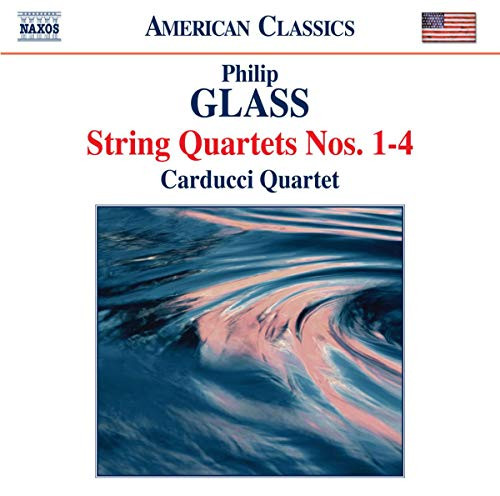
Product Description
Although Philip Glass came late to
the string quartet, his contribution
to the genre has since become a
significant one. This disc features
the first four of his five quartets,
ranging from the uncharacteristic
yet fascinating sound-world of the
First, through the compact
dimensions of the subsequent two
(themselves derived from theatre
and film scores). The more
expansive manner of his Fourth
Quartet makes allusions to the
formidable string quartet heritage,
in particular those of Schubert
and Dvorak.
Review
Philip Glass' two-movement 1966 First quartet bears gestural seeds of the repetitive style for which he's both deified and derided, although its dissonant idiom is light years removed from what we normally associate with this composer. Imagine late Shostakovich with the proverbial needle stuck in the groove (pardon my outdated vinyl LP reference!), or a louder, more loquacious Morton Feldman, and you'll get the idea.
Quartets 2 and 3 derive from theatrical scores. The Second comprises four brief interludes for Mabou Mines' staging of Samuel Beckett's prose-poem Company, and largely center around the key of A minor. Sound cues from Glass' soundtrack to Paul Schrader's film Mishima make up the Third's five movements. By contrast, the Fourth's three movements are larger in scale and more ambitious in terms of harmonic and textural scope. In fact, the first movement's long C major double-stop sequences wouldn't be out of place in Dvorák, while Beethoven's spirit seems to inform the third movement's sudden dynamic dips and surprising silences.
The Carducci Quartet more than holds its own in this repertoire alongside the Kronos and Smith Quartets. They match the Smith's tonal ripeness and dynamic breadth in No. 1, but with more liberal vibrato all around and stronger rhythmic accentuation in the first movement's climax. The Carducci's bass-oriented blend and somewhat statuesque treatment of the Second's third movement and the Third's finale markedly differ from the Kronos' lighter, more conversational repartee. On the other hand, the Carduccis bring more shapely profile to the accompanying patterns and sustained violin melodies of the Fourth's second movement than either of their estimable colleagues. And in No. 2's churning finale, the Carduccis strike a happy medium between the Kronos' delicate inner "swing" and the Smith's relat

String Quartets Nos 1-4
Was:
$77.88
Now:
$38.94
- SKU:
- ZC540658
- UPC:
- 636943963623
- Condition:
- New
- Availability:
- Free Shipping. Estimated 2-4 days delivery.

String Quartets Nos. 1 - 4
Was:
$137.40
Now:
$68.70


Fall of Baghdad- String Quartets Nos 1 4 and 5
Was:
$77.88
Now:
$38.94

String Quartets Nos 1-3
Was:
$88.36
Now:
$44.18

String Quartets Nos. 1 and 2
Was:
$98.54
Now:
$49.27