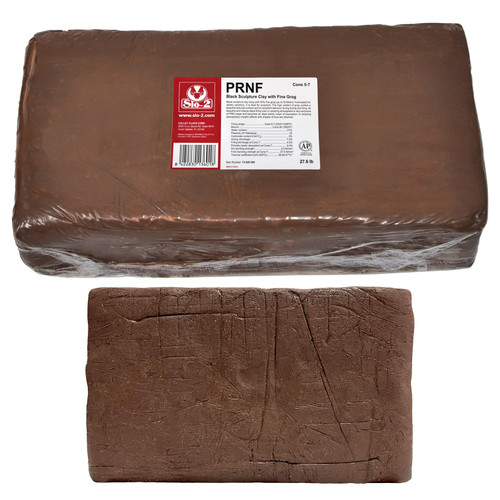
"Black sculpture clay with 40% fine grog 0-0.5 mm (up to 35 Mesh). Formulated for artistic ceramics, it is ideal for sculpture. The high content of grog confers a beautiful textured surface and an excellent behaviour during drying and firing. Its beautiful and intense black firing colour in oxidising atmosphere is very exclusive of PRN range and becomes an ideal artistic mean of expression. In reducing atmosphere, metallic effects with shades of blue are obtained. Available in extruded body (moist form). Firing range: 2205-2295°F / Cone 5-7 Biscuit temperature: 1855°F / Cone 06 Water content: 21% Plasticity (IP Atterberg): 22 Carbonate content (CaCO3): 0% Drying shrinkage: 7.0% Firing shrinkage at Cone 7: 4.5% Porosity at Cone 7: 9.4% Dry bending strength: 2.0 N/mm2 Fired bending strength at Cone 7: 27.5 N/mm2 Thermal coefficient (?25-500°C): 55.8x10⁻⁷°C-1 Recommendations for use with glazes Use zinc-free (Zn-free) glazes to prevent from unexpected reactions such as bubbling or colour changes. Other elements that can react are zirconium (Zr) and tin (Sn). We recommend consulting your usual glaze supplier to ensure proper suitability with this ceramic clay body. Do not use glazes with a low coefficient of thermal expansion (a25-300°C <60x10-7°C-1). The PRN clay fired at high temperature has a high coefficient of thermal expansion in the range of 100 to 200°C, which causes tensions between the glaze and the support, mainly in pieces glazed on one side only, which can cause breakage during cooling in the kiln or even later (for example, when pouring hot water inside). Check with your usual glaze supplier to ensure that you use glazes with a medium-high coefficient of thermal expansion (a25-300°C >60x10-7°C-1). Storage: Protect ceramic clay bodies from direct sunlight, avoiding excessive temperature changes and protect from frost. Use: Technical details are available with information on the characteristics of each product and its use. It is recommended to test clay body prior to large scale use in order to verify suitability in both the ceramic process (shaping, drying, firing and decoration) and the final application that is expected to be obtained. Safety: All SIO-2 clay bodies are certified by the Art & Creative Materials Institute (ACMI) and conform to ASTM D-4236 safety guidelines. From the manufacturer of SIO-2: CERAMICA COLLET S.A. Always in your hands Founded in 1874, our company manufactures ceramic clay bodies for industry, pottery and artistic ceramics, and natural clay for crafts, fine arts and education. Our target is to innovate, developing products made with natural clay which, in many applications, satisfy the high requirements of our customers. Our Quality System, certified according to ISO 9001:2008, is the setting for continuous improvement. Social responsibility, respect, and care for the Environment are two fundamental points in the philosophy of our firm. Ceramic body manufacturing process Clay mining from nature Clays are natural materials that are extracted from mines and open-pit deposits. The selection and origin of each type of clay depends on its desired physical characteristics (colour, plasticity, melting point, etc.). Receiving, mixing and grinding The clays arrive at the factory in a dump truck and are unloaded into the feed hoppers, where they are mixed and crushed through a continuous process. The result is a clay composition in a crumbled state that combines the specific clay formula to make a ceramic body. Clay storage The clay composition is controlled and stored in the external storage bays. With the storage, the homogenization of the components is obtained and the natural maturation and drying of the clay is favoured. Grinding The ceramic body manufacturing process begins with the dry grinding of the clay composition using pendular mills. The result is a clay composition in powder that flows through pipes (pneumatic transport) to the storage silos. Dosing, kneading and extrusion The clay composition is dry mixed with other solid components (grog, minerals, pigments) and is dosed with the liquid phase (water and additives) in an automatic process controlled by sophisticated dosing and weighing systems. The resulting formula is mixed in the kneader, obtaining a body in a plastic state, which is extruded in the form of a compact bar (under vacuum) with an automatically controlled consistency (hardness). Packaging and palletizing The extruded bar is cut into individual blocks (units) of defined and automatically controlled weight. The units travel through a carousel where they are automatically packed, labelled and palletized."

SIO-2 PRNF Black Sculpture High Fire Pottery Clay, 27.6 lb (12.5 kg) | Kiln-Fired Clay for Wheel-Throwing, Handbuilding & Modelling - Ready-to-Use
Was:
$145.20
Now:
$72.60
(No reviews yet)
Write a Review
Write a Review
SIO-2 PRNF Black Sculpture High Fire Pottery Clay, 27.6 lb (12.5 kg) | Kiln-Fired Clay for Wheel-Throwing, Handbuilding & Modelling - Ready-to-Use
- SKU:
- ZY645125
- UPC:
- 8422830136018
- Condition:
- New
- Availability:
- Free Shipping from the USA. Estimated 2-4 days delivery.