
Synonyms: Basic Blue 9,trihydrate; Methelyne blue trihydrate; 3,7-Bis(dimethylamino)phenazathionium chloride trihydrate CAS No.: 7220-79-3 (Trihydrate) Molecular Weight: 373.91 Chemical Formula: C16H18ClN3S . 3H2O In biology methylene blue is used as a dye for a number of different staining procedures, such as Wright's stain and Jenner's stain. Since it is a temporary staining technique, methylene blue can also be used to examine RNA or DNA under the microscope or in a gel: as an example, a solution of methylene blue can be used to stain RNA on hybridization membranes in northern blotting to verify the amount of nucleic acid present. While methylene blue is not as sensitive as ethidium bromide, it is less toxic and it does not intercalate in nucleic acid chains, thus avoiding interference with nucleic acid retention on hybridization membranes or with the hybridization process itself. It can also be used as an indicator to determine if a cell such as yeast is alive or not. The blue indicator turns colorless indicating living cells. However, if it stays blue it doesn't mean that the cell is dead or there are no cells. Methylene blue can inhibit the respiration of the yeast as it picks up hydrogen ions made during the process and the yeast cell cannot then use those ions to release energy. In neuroscience, methylene blue can also serve as a non-selective inhibitor of NO synthase. Wiki

Methylene Blue 1% Aqueous Stain dye Solution 1 Fl Oz 30ml
Was:
$56.78
Now:
$28.39
(No reviews yet)
Write a Review

Write a Review
Methylene Blue 1% Aqueous Stain dye Solution 1 Fl Oz 30ml
- SKU:
- ZT224470
- UPC:
- 784672263764
- Condition:
- New
- Availability:
- Free Shipping from the USA. Estimated 2-4 days delivery.
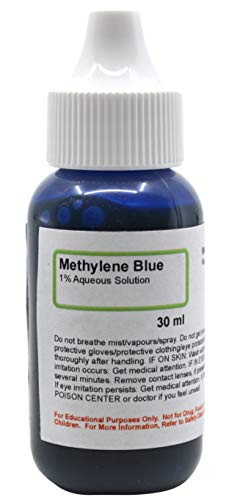
Methylene Blue 1% Aqueous Solution 1 fl oz 30mL - The Curated Chemical Collection
Was:
$46.08
Now:
$23.04

Methylene Blue, 100 mL Pharmaceutical Grade 1% Aqueous Solution USP 3.38 fl oz
Was:
$125.88
Now:
$62.94

Malachite Green 1 percent Aqueous Solution 1 fl oz -30mL- - The Curated Chemical Collection
Was:
$71.88
Now:
$35.94

Congo Red 1 percent Aqueous Solution 1 fl oz -30mL- - The Curated Chemical Collection
Was:
$71.88
Now:
$35.94
