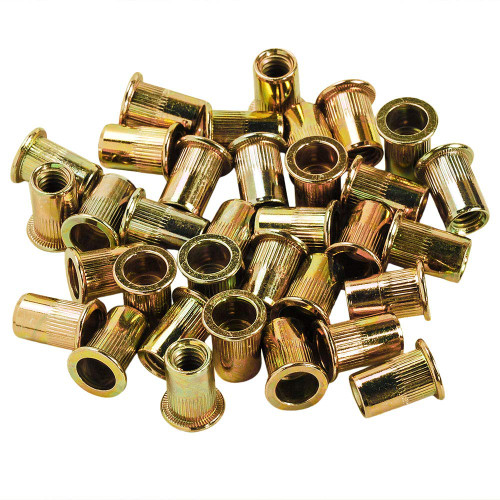
Specification: Head Type: Flat Head
Color: Yellow
Material: Carbon Steel
Surface treatment:Zinc Plating
Rivet Nut Size: 5/16''-18UNC
Grip Range:0.03-0.12inch
Body Diameter:0.526inch
Head Height:0.036inch
Overall Length:0.701inch
Hole Size of the Sheet:0.527min.-0.536max.
Use the right tool.
Spin-spin tool: The rivet nut is threaded onto the mandrel on the pneumatic power tool and then inserted into a hole on the workpiece. When the power tool is activated, the mandrel spins quickly to pull the threaded portion of the shank toward the blind side of the workpiece to form a bulge around the unthreaded portion. When the bulge pushes against the back of the panel, it creates a clamping force to grip the sheet. Once the rivet nut is securely clinched in place, the mandrel spins in the opposite direction to unthread itself from the nut, leaving the rivet nuts internal threading intact.
Spin-pull tool: Similar to the spin-spin tool, an air motor is used to thread the nut onto the mandrel. When the rivet nut is inserted into the workpiece, hydropneumatic pressure is used to pull the mandrel back a set distance in order to set it. Then, the air motor is re-engaged to pull the mandrel out of the rivet nut. These tools are great for plastic workpieces.
Pull-to-pressure tool:this tool works the same as a spin-pull tool except that instead of pulling to a specific distance, it pulls to a set pressure. When the fastener is placed into the workpiece, hydropneumatic pressure is used to pull back the mandrel. Then, when the preset pressure is achieved, the air motor backs the mandrel out of the nut. If you are fastening metal or a hard plastic, a pull-to-pressure tool is ideal and consistent.

Thread Insert Rivnut 80pcs 5 16-18 UNC Flat Head Rivet Nuts Carbon Steel with Yellow zinc Plating Knurl Body?Corrosion Resistance Applicable for Thin Sheet Metal.
Was:
$67.88
Now:
$33.94
(No reviews yet)
Write a Review

Write a Review
Thread Insert Rivnut 80pcs 5 16-18 UNC Flat Head Rivet Nuts Carbon Steel with Yellow zinc Plating Knurl Body?Corrosion Resistance Applicable for Thin Sheet Metal.
- SKU:
- ZT111028
- UPC:
- 798818494820
- Condition:
- New
- Availability:
- Free Shipping from the USA. Estimated 2-4 days delivery.